 Duckweed Atlas
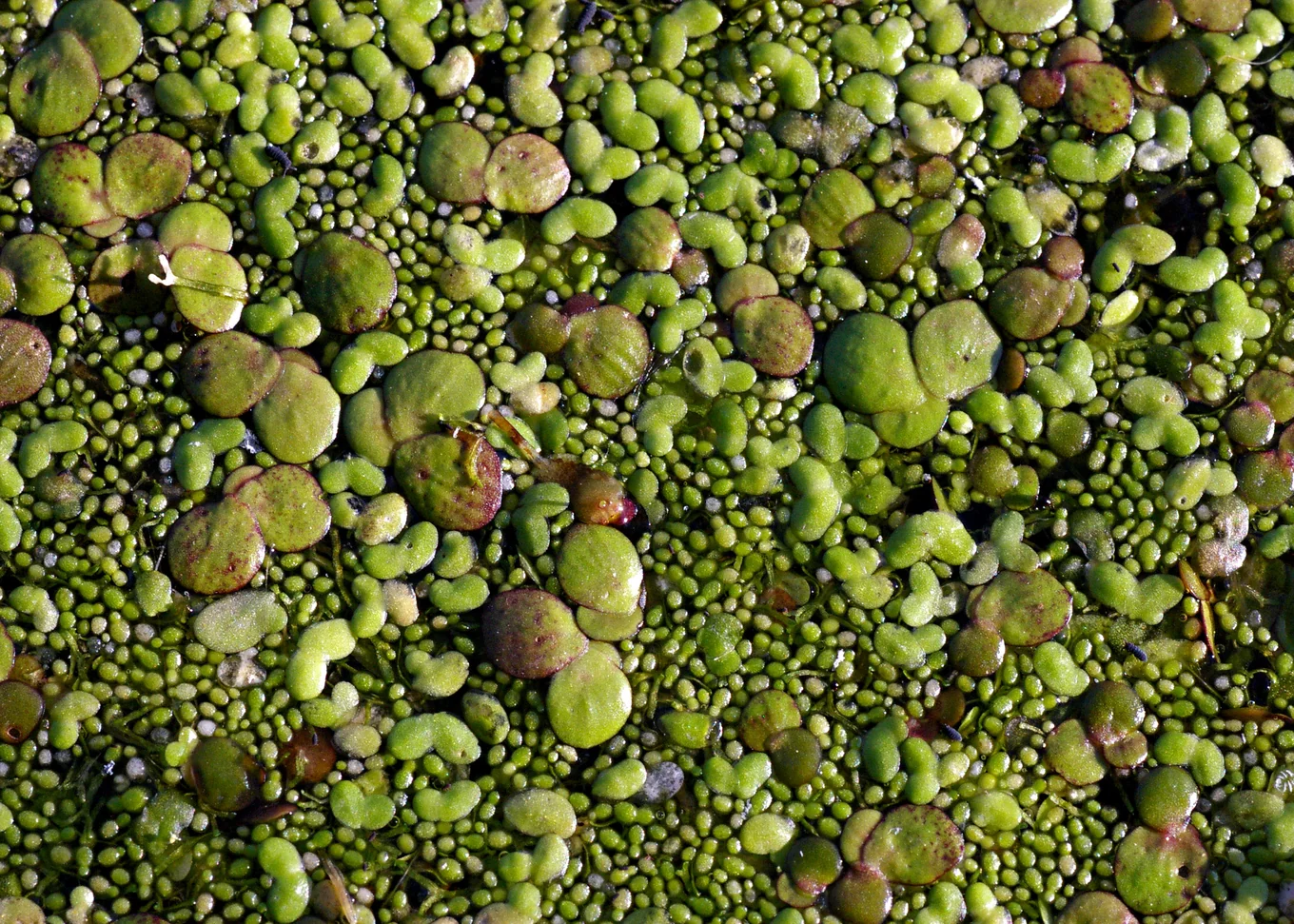

What duckweed is
Duckweeds are miniature aquatic flowering plants, usually placed in Araceae under Lemnoideae. Lemnaceae is widely used in older literature and by some specialists. They generally spread by budding daughter fronds. Flowers and seeds occur in some settings, and some taxa make dense resting buds called turions. A frond is the small plant body seen floating on the surface. Acosta et al. 2021
The five genera
| Genus | Field clue | Where to start |
|---|---|---|
| Spirodela | Broad floating fronds, usually several roots per frond | Greater duckweed, S. polyrhiza, is a familiar species in ecological research. |
| Landoltia | Several roots, typically smaller and narrower than greater duckweed | L. punctata is often called dotted duckweed and appears in growth and nutrient studies. |
| Lemna | Usually one root per frond. Shape and flotation vary between species. | L. minor and L. gibba appear in food research. L. trisulca can grow submerged. |
| Wolffiella | Rootless, often thin and elongated or tongue-like | W. hyalina was identified as a composition research candidate. Spell out the genus to avoid confusing it with Wolffia. |
| Wolffia | Rootless, often small, grain-like bodies. Frequently called watermeal. | W. globosa and W. arrhiza have fresh-food regulatory records. W. australiana is a genomics model. |
The table is a genus-level guide. Photograph both sides with a scale, note roots before handling breaks them off, and record location and date. Mixed mats are common. Where an identification affects food, trade or research validity, get specialist confirmation and use an authenticated accession. Acosta et al. 2021 · Rutgers Duckweed Stock Cooperative · Royal Botanic Gardens, Kew · Michael et al. 2021 · Appenroth et al. 2017 · European Commission 2021
Species and strains with human-food evidence
| Taxon or material | What is documented | How to use the evidence |
|---|---|---|
| Wolffia globosa | Thai vegetable use, specified EU fresh-food authorization, and studies of the cultivated Mankai strain | A starting species for culinary sourcing. Match food form and traceability before using the evidence. Japan International Research Center for Agricultural Sciences 2010 · European Commission 2021 · Kaplan et al. 2019 |
| Wolffia arrhiza | Included in the specified EU fresh-food authorization alongside W. globosa | Recognize that published traditional names can cover more than one species. European Commission 2021 · EFSA 2021 |
| Mankai, a cultivated W. globosa strain | Most of the human intervention literature here uses this particular material | Record the strain and processing used in the study. A branded strain and a species name resolve different levels of identity. Kaplan et al. 2019 · Sela et al. 2020 · Tsaban et al. 2024 |
| Lemna minor and Lemna gibba | Specified heat-treated whole material and a separate concentrate have EU entries | Check the exact form and manufacturing or composition conditions. European Commission 2025 · European Commission 2024 |
| Wolffia microscopica and Wolffiella hyalina | Raised as composition research candidates in comparative work | Useful research leads. Traceable retail food and jurisdiction-specific status require their own evidence. Appenroth et al. 2017 · Appenroth et al. 2018 |
What a clone number tells you
A clone or accession anchors a record to documented plant stock. Record the accepted name, accession, collection and original label or synonym. A culture may contain multiple clones, and morphology can overlap between species. A stock collection can help you reproduce an experiment. Food production also needs control of water, inputs and the finished batch. Acosta et al. 2021 · Rutgers Duckweed Stock Cooperative · Appenroth et al. 2018
See Buying & sourcing before ordering a product or starter and Food regulations for product-specific rules.
Sources for this page (14)
- Return of the Lemnaceae: duckweed as a model plant system
- Duckweed clone database
- Wolffia globosa in Plants of the World Online
- Genome and time-of-day transcriptome of Wolffia australiana
- Nutritional value of duckweeds as human food
- EU 2021/2191: fresh Wolffia plants
- Wolffia globosa in the Thai vegetable database
- Protein bioavailability of Wolffia globosa duckweed
- Fresh Wolffia arrhiza and Wolffia globosa traditional food technical report
- Wolffia globosa–Mankai contains bioactive vitamin B12 and is well absorbed in humans
- Mankai and postprandial glycaemic response in adults with type 2 diabetes
- EU 2025/153: Lemna minor and Lemna gibba plants
- EU 2024/1048: Lemna protein concentrate
- Nutritional value of the duckweed species of the genus Wolffia as human food
Sources checked November 21, 2026